Featured Project
Case Study 06 — Full Suite
AI Automation Suite — Production Implementation
Six connected n8n workflows — support, sales, finance, BI, HR/IT, and a knowledge-indexing layer underneath all of it — running as one system for a real client, not six separate demos.
n8n (self-hosted)
Google Gemini 1.5 Flash
Supabase Postgres + PGVector
HubSpot
Slack
Google Workspace
Watch the complete system in action — all 6 workflows executing live.
What this project actually is
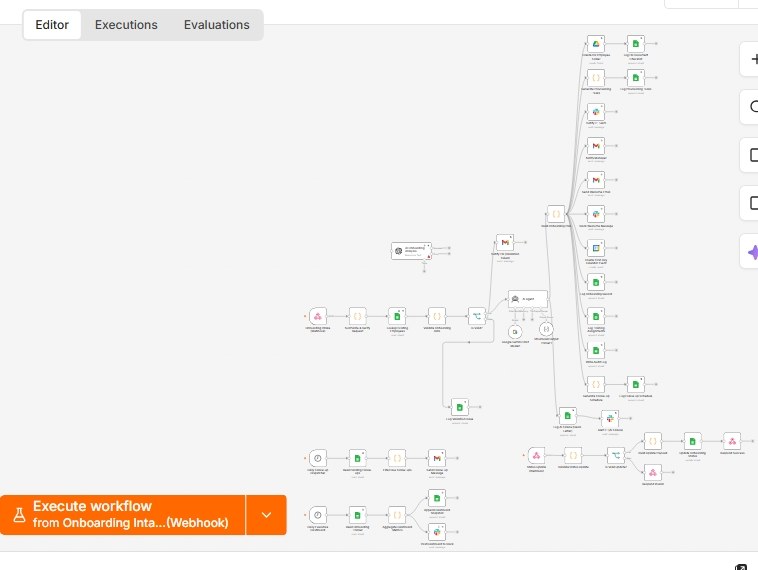
Look at case studies 01 through 05 above — the support assistant, the lead qualification pipeline, the invoice processor, the executive dashboard, the onboarding system. Each one is documented on its own because each one is a distinct, reusable pattern. This project is what happened when a client needed all five, wired together, plus a sixth piece underneath: a vector knowledge-base indexing layer that keeps the support assistant's answers grounded in the client's actual documentation instead of a static FAQ.
Built in two weeks, self-hosted on n8n rather than a metered cloud platform, and running against the client's real traffic since launch. n8n was the right call here — fast to ship, fully self-hosted, no per-task billing. The same architecture (validation → routing → confidence-based handling → audit trail) carries over just as cleanly to Make, a custom Python/Node service, or a full SaaS backend when that's the better fit for a client's stack or scale — see the Platforms & Stack section for the fuller picture.
$190K
Client-reported annual savings
99.5%
Uptime target, self-hosted
Six Production Workflows
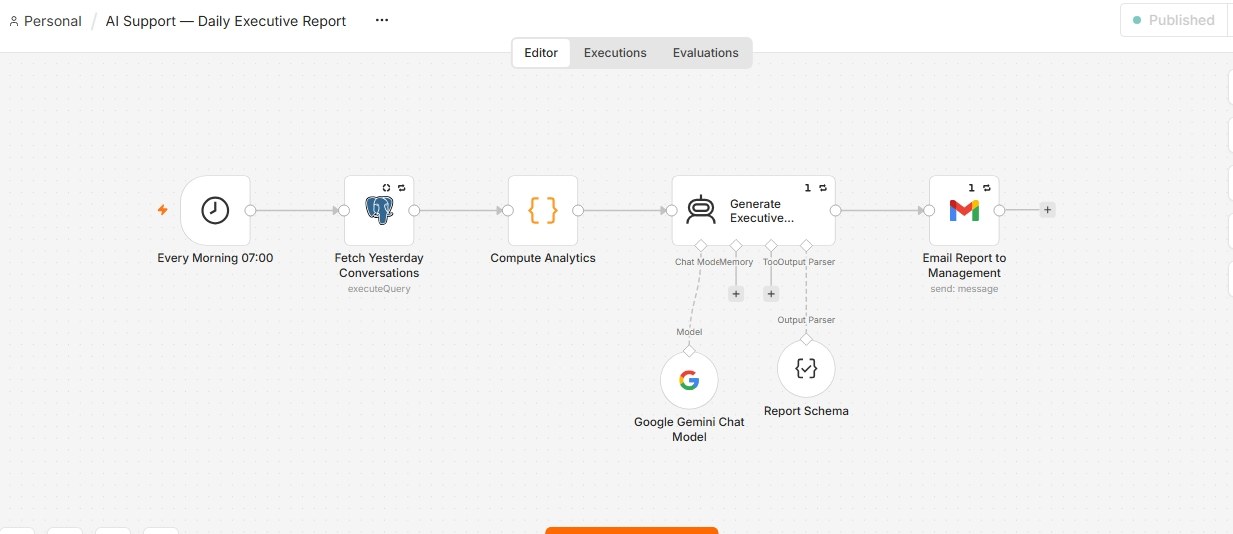
01 — Scheduled Analytics
Daily Executive Report
Postgres · Gemini · Gmail
Fetches the last 24 hours of support conversations, computes resolution rate, escalation rate, sentiment, and response time, then emails a structured executive summary at 7am — automatically, every day, including quiet days.
~12s execution time
Runs honest — reports real zeros, not silent failures
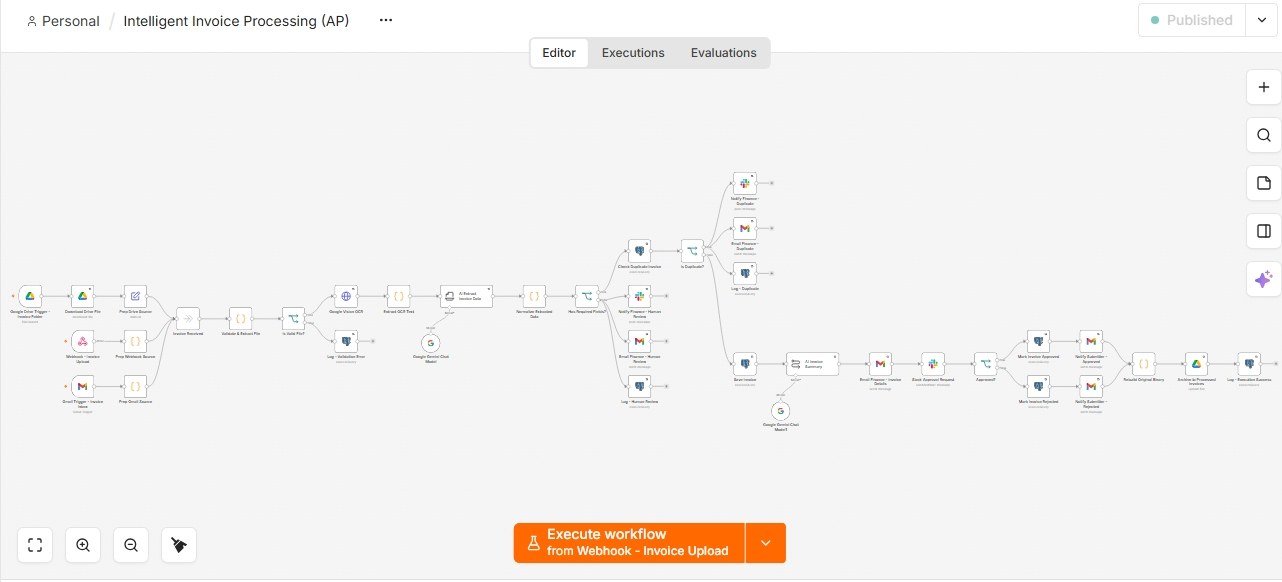
02 — Document Automation
Intelligent Invoice Processing
Google Vision OCR · Gemini · Drive
Three intake channels feed one pipeline: OCR extracts vendor, amount, date, tax, and line items; the system checks for duplicates before booking, routes for Slack/email approval, and archives the processed file automatically.
~4.3s per invoice
Duplicate detection before booking
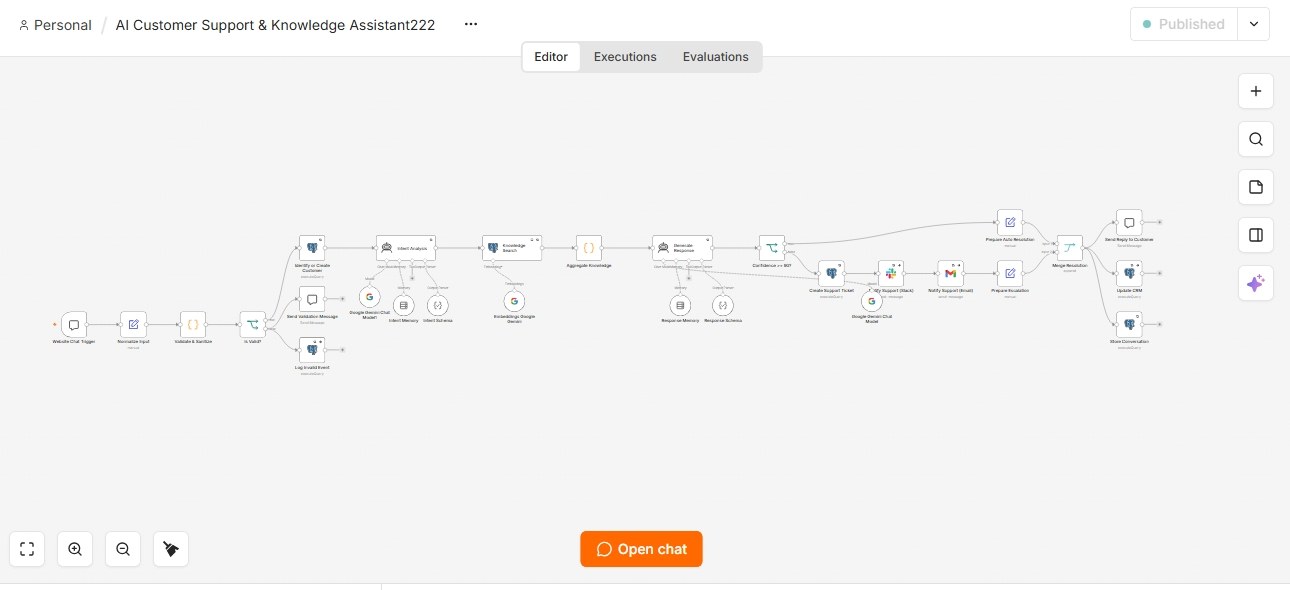
03 — Webhook Service
Real-Time Customer Support AI
OpenAI/Gemini · PGVector · Slack
A live webhook endpoint that validates the inbound message, classifies intent and confidence, retrieves grounded context from the vector knowledge base, and either resolves automatically or escalates with a written summary attached.
Confidence-routed, not scripted
Grounded in the client's actual docs
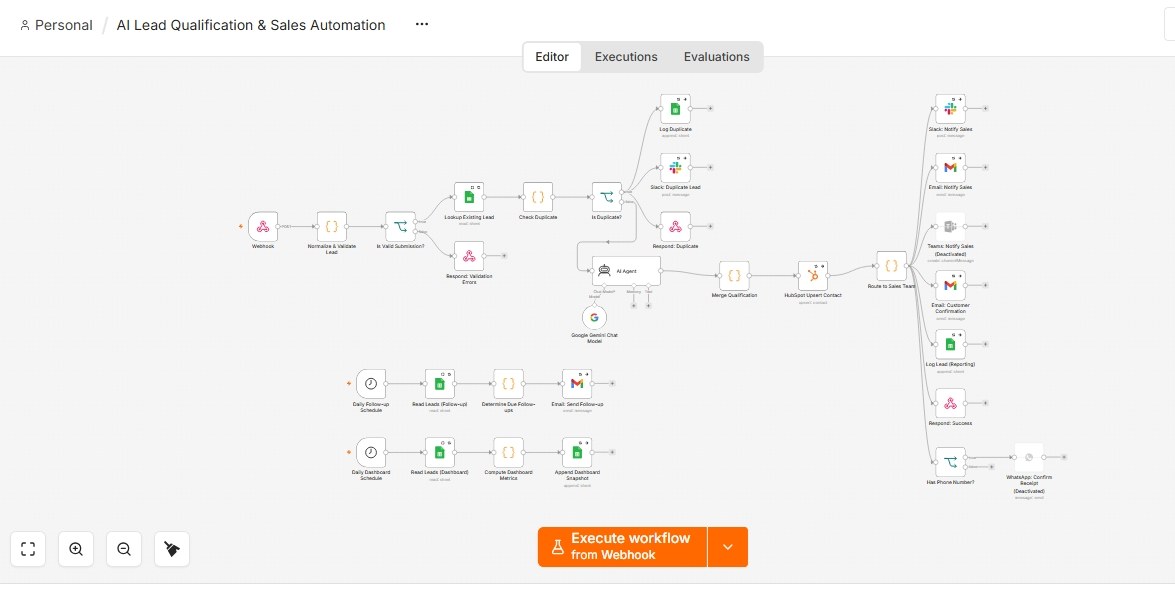
04 — Sales Automation
AI Lead Qualification & Scoring
HubSpot · WhatsApp · Teams
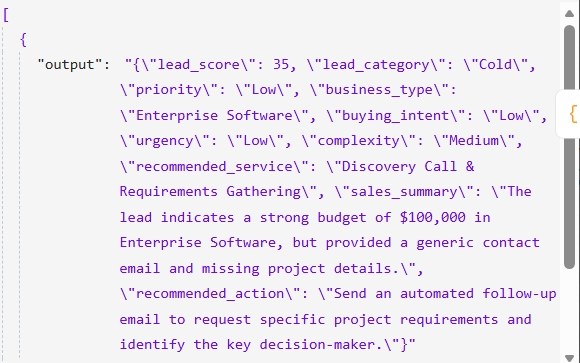
Scores every inbound lead 0–100 on budget, timeline, industry fit, and urgency, returns a structured recommendation, and syncs straight to HubSpot — with automatic follow-up scheduling for anything that stalls.
100% lead coverage, no manual triage
05 — HR Automation
Employee Onboarding & IT Provisioning
Google Calendar · Sheets · Slack
Builds a role-specific onboarding plan for every new hire — checklist, training path, equipment list — then provisions the HR/IT tasks and notifies every stakeholder automatically, with its own follow-up cadence.
Full personalization by role
06 — Data Pipeline
Vector Knowledge Base Indexing
Gemini Embeddings · PGVector
The layer that makes workflow 03 trustworthy: indexes the client's documentation into a Postgres/PGVector store using Gemini embeddings, so the support assistant's answers are grounded in real source material instead of a static, hand-maintained FAQ.
Powers semantic search for the support AI
Built With Modern AI Stack
Orchestration
n8n (Self-Hosted)
Open-source workflow automation. Full control over data and cost, zero per-task vendor lock-in.
AI Engine
Google Gemini 1.5 Flash
Fast inference, generous free tier, and reliable structured JSON output for every reasoning step.
Data Layer
Supabase — Postgres + PGVector
Managed Postgres with vector embeddings built in — one database for records and semantic search.
Results & Financial Impact
Figures below are client-reported, based on time-tracking comparisons before and after launch.
| Workflow | Before | After | Monthly Savings |
|---|
| Invoice Processing | ~10 min / invoice | ~4.3 sec / invoice | $5,000 |
| Customer Support | ~10 min / ticket, manual | AI-resolved in seconds | $7,000 |
| Lead Qualification | ~20 min / lead, manual | Scored automatically | $2,500 |
| Onboarding Efficiency | Manual checklist assembly | Auto-generated per role | $1,200 |
| Total monthly savings | $15,875 |
~$1,800
Annual system cost
$188,700
Net annual benefit
Production-Grade Architecture, Not a Prototype
Every workflow in the suite shares the same discipline as the case studies above:
- —Automatic retry logic with exponential backoff on every external call
- —Dead-letter queue and audit log for every failed transaction
- —Real-time Slack alerts the moment anything fails
- —Structured, schema-validated AI output — no free-text parsing, no hallucinated fields
- —Webhook token validation and SSL/TLS on every external endpoint
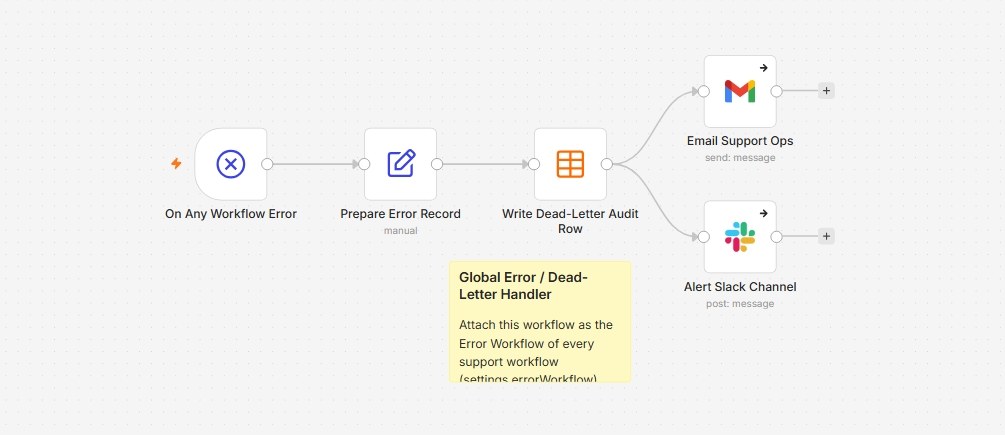
One error workflow, attached to every workflow in the suite — nothing fails silently.
What I Learned Building This
Architecture beats stack
Self-hosted n8n over a metered cloud platform cut ongoing cost dramatically while giving full control over LLM integration and data residency.
Structured output eliminates hallucination-shaped bugs
Enforcing a JSON schema on every AI step meant no post-processing, no regex patching, and no silent malformed data reaching a database.
Measure business impact, not just technical metrics
Response-time and confidence numbers matter to me. Dollar figures are what make the case undeniable to whoever is signing off on the project.
Documentation scales ownership
A well-documented system is a low-touch system — less on-call burden, faster handoff, easier for a client's own team to eventually maintain.
Simplicity outperforms cleverness
The highest-impact workflow here is also the simplest: upload → OCR → extract → validate → save. No workflow needed more cleverness than the problem demanded.
Documentation & Technical Specs
Full write-ups for technical review — these go out on request rather than as public downloads, so I know who's reading them.
Technical Specification
Architecture, database schema, deployment procedure, and operational runbooks.
Request the PDF →
Executive Summary
One-page overview: business results, ROI, and production-readiness checklist.
Request the PDF →
Want a system like this for your team?
Whether it's one workflow or all six connected together — I'm available for architecture consulting, implementation, or a review of what you've already got.